|
Information Page Links:
Featured EMI Shielding Manufacturers
About EMI Shielding
EMI Shielding Terms
EMI Shielding Associations
EMI Shielding Resources
Trade Shows
Featured EMI Shielding Articles
More Articles
|
|
About EMI Shielding
EMI shielding and EMI filter reflects, absorbs or redirects
electromagnetic waves to prevent interference from affecting sensitive
equipment. EMI is any electrical signal that disturbs the function of
a circuit, cable or other electronic component. EMI can originate from
other equipment or from the affected component itself. The number of
electromagnetic signals has increased with the ever growing use of computers,
mobile phones and other electronic equipment. The EMI caused by these
signals necessitates protective materials to avoid diminished product
performance or product failure. EMI shielding and EMI filters can be
found in medical devices, computers, mobile phones, stereo systems, television
sets, windows, vents, fabrics, foils and even walls.
There are many forms of EMI shielding. Sheet metal provides excellent
shielding effectiveness, environmental reliability and abrasion/scratch
resistance. However, its design versatility is poor. Conductive paint
provides good to very good shielding effectiveness, good design versatility,
fair to good environmental reliability and poor to good abrasion/scratch
resistance. Electroless
plating gives excellent shielding effectiveness
and is highly resistant to abrasion. Its design versatility is good to
excellent and is quite environmentally reliable. Conductive plastics
have excellent resistance to abrasion, good shield effectiveness and
environmental reliability and fair design versatility. Vacuum metallization
provides very good shielding performance and excellent electrical continuity
at the surface and has virtually no effect on the environment. Molding
cosmetics are possible with select coatings. The disadvantages of vacuum
metallization include line-of-sight operation, which limits part complexity,
and limited sources of supply. Spring gaskets provide long-term durability
and reliability, high shielding effectiveness, consistent shielding despite
surface irregularities and tolerance variations and are easy to assemble
and install.
EMI/RFI gaskets are the most effective, simplest and most inexpensive
method of shielding available, because they prevent the occurrence of
slot antennas. Ferrite designs are made with solid and split beads arranged
in versatile geometries and with many types of material compounds, and
they offer many installation alternatives. Copper alloy gaskets are among
the strongest gaskets available and come in a wide selection of profile
shapes and sizes to meet any specification. Canted spring gaskets have
superior shielding ability, excellent spring properties and compact configurations
and are reliable. EMI gaskets eventually lose flexibility from compression
set or thermal cycling and undergo torquing that will produce unwanted
variations. Even conductive elastomers possibly the highest performing
class of EMI gaskets, will deform under load over time, due to their
low elastic limit. Some gaskets have closely aligned coils that maintain
constant metal-to-metal contact to counteract the negative effects of
regular wear and tear. High performance EMI/RFI gaskets are utilized
in the following industries: aerospace, defense electronics, medical
electronics, interconnections, automotive electronic and any other industry
utilizing sensitive equipment.
There are also a variety of EMI coatings available. Commonly used conductive
coatings are aluminum, copper, silver and gold and can meet up to one
ohm per square inch resistance. Reflective coating is typically used
on plastic or glass. This type of coating is used on such things as light
bulbs and aircraft navigational lamps to dramatically increase light
output. Reflective heat shield coatings can shield and reflect all electromagnetic,
heat or infrared waves. This process is commonly used on light fixtures
to prevent housing from overheating and increase light output but can
also be used on satellite components and everything in between. Magnesium
fluoride is applied to glass to produce an extremely hard, anti-reflective
coating, providing an average of less than 2% reflection. Dielectric
coatings are non-conductive thin films used as insulators or protective,
scratch-resistant coatings that are applied to substrates. Metals, plastics
or glass are the most commonly used, though other materials such as aluminum
oxide and silicone oxides are also used, depending on the application.
Featured
Articles
http://www.spira-emi.com/theory.htm
http://www.spira-emi.com/references/pdf/kunkel_mech_force_considerations.pdf
Types of EMI Shielding
- ,
also known as "EMI coatings," are used to coat plastics to
prevent EMI and ensure electromagnetic compatibility (EMC). Conductive
coatings, which are becoming more common as the use of plastic in the
electronic industry increases, provide good adherence and resistance
to environmental factors.
- minimizes electromagnetic interference and electrostatic discharge.
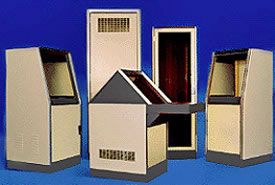
- are areas from which EMI/RFI is blocked. EMI enclosures
include electronic enclosures, chambers, walk-in enclosures and enclosed
rooms.
- consist of beads, blocks and bars of metal oxides that
protect electronic components by blocking absorption of the interfering
waves.
- ,
or "EMI/RFI filters," are used to filter unwanted EMI and
RFI signals from circuits and power lines. EMI filtering often utilizes
low pass filtering, a process in which high-frequency RFI is attenuated
while low frequencies are allowed passage through the filter.
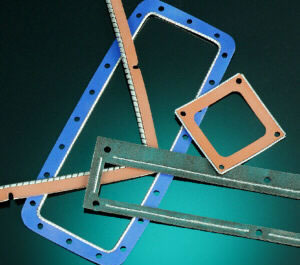
- are manufactured from materials such as foam, fabric,
metal or wire mesh and shield gaps between electronic components.
- protects equipment from magnetic fields.
- protects equipment from interference from radio waves.
|
|